


 English
 Español
 Français
Home / News / Industry News / Hospital Sterilization Equipment: How to Plan a CSSD Workflow That Works
News


Hospital Sterilization Equipment: How to Plan a CSSD Workflow That Works
 2026.11.05
 Industry News
A hospital in the middle of a CSSD upgrade had budgeted for two steam sterilizers. The sterilizers were the easy part. What pushed the project back by three months was the drying cabinet that arrived without a matching cart, the packing table that blocked a door swing, and a new washer-disinfector whose hot drain water the old floor channel could not take. Hospital sterilization equipment almost never fails as a single machine. It fails as a chain with one weak link.
So the conclusion first: design the workflow and the load mix, then size the equipment around them. Buy the chain, not the hero machine. Everything below explains what that means in practice, where the hidden costs sit, and which specifications are worth arguing about before you sign.
Content
- 1 What Counts as Hospital Sterilization Equipment
- 2 The Four Zones That Decide Whether a CSSD Works
- 3 Cleaning First: Washer-Disinfectors and What Sits Around Them
- 4 Steam Sterilizers: Match the Cycle to the Load, Not the Catalogue
- 5 Monitoring: The Part Buyers Underestimate
- 6 Specifications and Procurement Risks Worth Checking Before You Sign
- 7 Where Eray Sits in This Chain
- 8 Frequently Asked Questions
What Counts as Hospital Sterilization Equipment
Regulators describe sterilization in terms of chemistry: the FDA lists moist heat, dry heat, radiation, ethylene oxide, and vaporized hydrogen peroxide as the main routes for medical devices. A hospital tender, however, is organised by workflow stage, and the items in it answer very different questions. Grouping them this way makes a budget easier to defend and a spec easier to write.
| Workflow stage | Typical equipment | Standard usually referenced |
|---|---|---|
| Cleaning and disinfection | Washer-disinfectors, ultrasonic cleaners, vacuum boiling washers, cleaning sinks, air and water guns | EN ISO 15883 series |
| Drying and inspection | Drying cabinets, illuminated magnifiers, packing tables, workbenches | Local SOP plus ISO 15883 validation data |
| Packaging | Heat sealers, pouch cutters, nonwoven wrap, rigid containers | EN ISO 11607 |
| Sterilization | Gravity and pre-vacuum steam sterilizers, low-temperature units, pharmaceutical sterilizers | EN 285, ISO 17665 |
| Monitoring | Chemical indicator cards and labels, indicator tape, Bowie-Dick packs, biological indicators, readers | EN ISO 11140, EN ISO 11138 |
| Transport and storage | Closed transfer trolleys, pass-through windows, sterile storage cabinets, basket racks | Facility infection-control policy |
Two consequences follow. First, a budget line that funds only autoclaves will be topped up later at a worse price, because drying, sealing, and monitoring are what actually release a load. Second, the standards differ by group, so a single "CE marked" sentence across an entire tender rarely covers every item on the list.
The Four Zones That Decide Whether a CSSD Works
Almost every functional problem in a sterilization department traces back to one rule being broken: contaminated and sterile items must never share air, a corridor, or a pair of hands. The building is therefore divided into a one-way sequence, and each zone has its own equipment logic.
One-way flow through four zones. Each transfer point is a controlled boundary, not a doorway.
In the decontamination zone, the practical details are drain temperature limits, floor loading, and whether the washer is a single-door or double-door unit. A double-door machine that opens into the clean side removes an entire trolley trip. In the clean zone, the constraints are work surface depth, lighting, and the number of sealing stations per technician — not the brand of the table.
If the terminology is still new to your team, our plain-language overview of what a CSSD device is walks through the same layout room by room and is useful for briefing non-clinical purchasers.
Cleaning First: Washer-Disinfectors and What Sits Around Them
Most failed sterilization cycles blamed on the sterilizer are really cleaning failures. Dried blood, protein, and biofilm on a hinge or inside a lumen form a physical barrier that steam cannot reliably penetrate, and residual soil can protect organisms through a full exposure phase. That is why EN ISO 15883 wash cycles are validated using a defined A0 value — a way of expressing the microbicidal effect of a time-and-temperature combination at 80 to 95 degrees Celsius — rather than an arbitrary "hot wash".
When comparing machines, these are the points that change daily experience:
- Rack and spray-arm design, because a basket that holds your actual instrument sets is worth more than a larger chamber that fits none of them.
- Cycle documentation and batch traceability, since an auditable printout is what gets you through an inspection.
- Water quality and final rinse temperature, which affect spotting and drying time more than most buyers expect.
- Drain temperature tolerance, a small detail that has stopped more installations than any electronics fault.
For narrow lumens, joints, and complex instruments, an ultrasonic cleaner or a vacuum boiling washer usually sits upstream of the washer-disinfector. They are not interchangeable with it, and a tender that lists one without the other often ends up with an under-specified room.
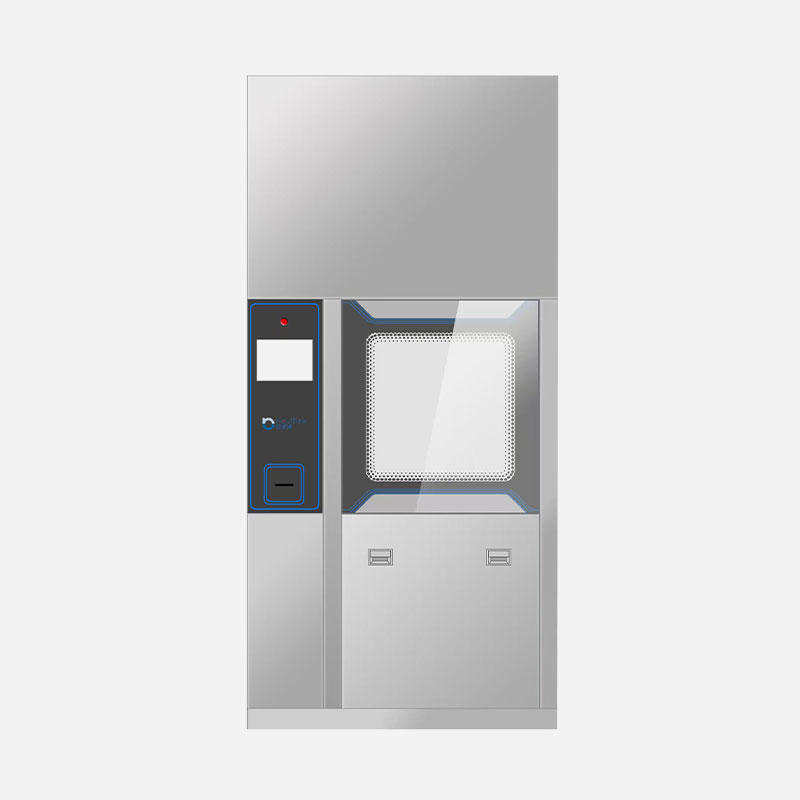 ND-300 and ND-600 Instrument Washer DisinfectorsTwo washer-disinfector models automate washing, thermal disinfection, and drying; ND-600 offers 30-minute cycles and heat recovery, while ND-300 adds HEPA 14 hot-air drying.View Product →
Steam Sterilizers: Match the Cycle to the Load, Not the Catalogue
Steam remains the default for hospital sterilization because it is fast, non-toxic, cheap per cycle, and well understood. The choice that matters is not the brand but the air-removal method. Gravity displacement units push air out with steam and suit simple, solid, unwrapped items. Pre-vacuum units use vacuum and pressure pulses to strip air out of wrapped sets, porous material, and lumens, where trapped air becomes an insulating pocket and a cold spot.
Exposure times published by the CDC make the difference in productivity visible, though it is worth remembering that these are holding times only — come-up, drying, and cooling are additional.
Steam exposure (holding) time by cycle type
Figures from CDC guidance on steam sterilization. Total cycle length also includes conditioning, drying, and unloading.
Phase sequence of a pre-vacuum steam cycle. Segment widths are schematic; durations depend on chamber size, load, and vacuum depth.
Chamber sizing is usually argued about in litres and should be argued about in trays per cycle instead. Ask how many wrapped sets of your standard configuration fit on one rack, then multiply by usable cycles per shift. A larger chamber that no one can load efficiently is a capital cost with no throughput gain.
Steam supply quality deserves the same attention as chamber volume. EN 285 sets expectations for dryness, non-condensable gases, and superheat in the supply steam; wet or contaminated steam produces failed Bowie-Dick tests and unexplained load rejections long after installation. Confirm line capacity, pipe insulation, and the position of the pressure-reducing valve before the machine arrives.
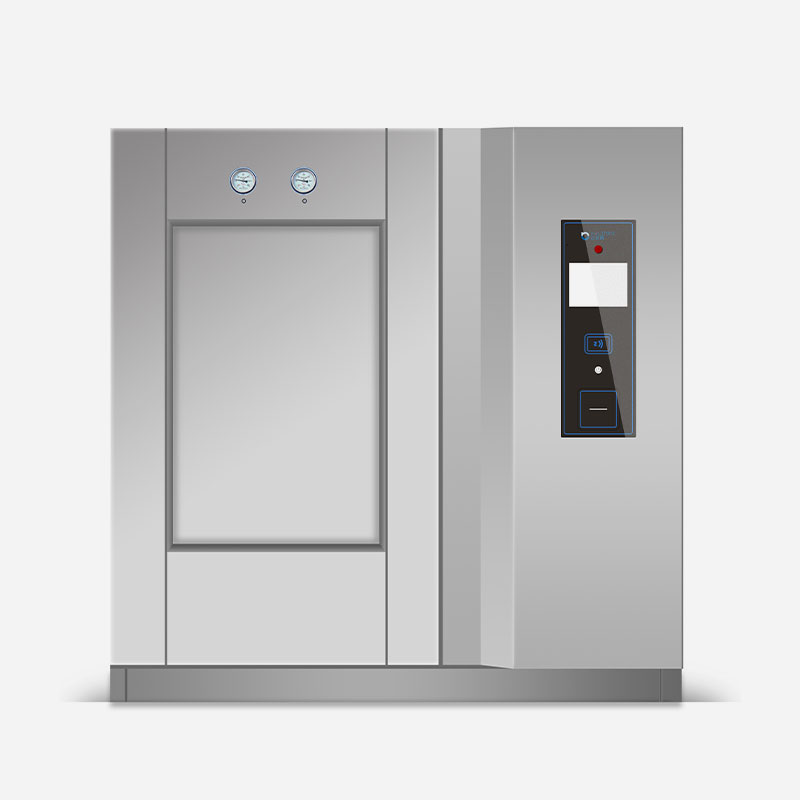 NS Series Steam Sterilizers with Pulsating VacuumPulsating-vacuum steam sterilizers with AISI 316L chambers from 360 to 1500 L, touch displays on both sides, and load capacities up to 18 STUs.View Product →
Monitoring: The Part Buyers Underestimate
An autoclave does not sterilize anything by itself; it executes a validated cycle that you then have to prove. That proof comes from three layers of monitoring, and each layer answers a different question.
- Chemical indicators, specified under EN ISO 11140, show that a package or load was exposed to the cycle conditions. A colour change confirms exposure, not sterility.
- Biological indicators, under EN ISO 11138, contain spores that are far harder to kill than typical contaminants and provide the real assurance that the cycle worked.
- A Bowie-Dick test, run at the start of the day on a pre-vacuum sterilizer, checks air removal and steam penetration rather than lethality.
Widely followed practice under AAMI ST79 runs a biological indicator at least weekly per sterilizer, and on every load containing implants; your local policy may be stricter. What purchasers often miss is the operational side: how many indicators per box, whether the reader is compatible with the specific indicator, and how long results must be retained. A load released on an unverifiable record is a compliance risk, not a paperwork problem.
 Self-Contained Biological Indicators BI101–BI104Self-contained indicators with ATCC 7953 spores and fluorescent results in 30 minutes, compatible with dedicated readers for routine sterilization monitoring.View Product →
Specifications and Procurement Risks Worth Checking Before You Sign
Most disputes after delivery are not about performance. They are about scope. The table below lists the checks that catch the majority of them.
| Check | What to verify | Risk if skipped |
|---|---|---|
| Footprint and service access | Manufacturer drawing with door swing, rear and side clearance, and lifting route | Machine delivered but not installable; corridor or door modification costs |
| Utilities | Steam capacity and quality, softened or purified water, compressed air, drain temperature, electrical load | Late building works and a sterilizer that fails validation |
| Load compatibility | Tray count per cycle for your own instrument sets, plus lumen and porous load limits | Throughput shortfall during peak surgical lists |
| Documentation package | Type test reports, validation and IQ/OQ support, calibration certificates, spare parts list | Delayed accreditation and unplanned downtime |
| Consumables continuity | Indicator and packaging supply terms, shelf life, and reader compatibility | Loads on hold because a single consumable ran out |
Where Eray Sits in This Chain
Eray Medical Technology (Nantong) Co., LTD. is a medical device manufacturing enterprise integrating research and development, production, and sales. The company is located in Rudong Economic Development Zone, adjacent to Shanghai, with convenient transportation and developed information. As a professional medical devices manufacturer and medical consumables factory, the company covers an area of 70 mu with a construction area of 20,310 square meters. It operates an ISO Class 8 cleanroom, an ISO Class 7 microbiological laboratory, and a partial ISO Class 6 physical and chemical laboratory. Eray has established a comprehensive quality control system covering the entire production process, including testing and traceability, from the ISO Class 8 cleanroom to the partial ISO Class 6 physical and chemical laboratory, ensuring that every customer receives trustworthy products.
In practice that breadth matters for CSSD projects. The product range runs from stainless steel work benches, cleaning sinks, drying cabinets, sealing machines, and transfer trolleys through washer-disinfectors, steam sterilizers, and vacuum boiling washers, and on to indicators, nonwoven wrap, and biological readers — so a department can be equipped as a workflow rather than as a set of unrelated purchases. With ISO 13485 certification and CE marking or FDA listing on selected products, the company supplies hospitals and distributors internationally. For specifications, drawings, or a quotation built around your load list, the team can be reached through the contact page.
Frequently Asked Questions
Q1. What is the difference between a washer-disinfector and a sterilizer?
A washer-disinfector cleans and thermally disinfects at roughly 80 to 95 °C, reducing bioburden. A sterilizer kills all microorganisms with saturated steam at 121 to 134 °C. Cleaning must come first, because soil inside a hinge can shield bacteria through a full steam cycle.
Q2. Do I need a pre-vacuum sterilizer or is gravity enough?
Gravity units suit simple solid items and unwrapped loads. Wrapped sets, porous material, and narrow lumens trap air, so pre-vacuum or steam-flush pressure-pulse cycles are the practical choice for a modern instrument inventory.
Q3. How often should biological indicators be used?
Common practice under AAMI ST79 is at least weekly for each sterilizer, plus every load containing implants. Local infection-control policy may require more frequent testing, especially after repairs or cycle changes.
Q4. Which utilities must be confirmed before delivery?
Steam capacity and quality, softened or purified water, compressed air, drain temperature tolerance, and electrical load. Steam dryness and non-condensable gas levels affect validation results more than supply pressure alone.
Q5. How much space does a sterilization department need?
Enough for four separated zones plus door swing, trolley turning circles, and service access behind and beside each machine. Work from the manufacturer's installation drawing, since catalogue footprints usually exclude maintenance clearance.
Q6. Which standards should a tender reference?
EN 285 and ISO 17665 for steam sterilizers, EN ISO 15883 for washer-disinfectors, EN ISO 11140 and EN ISO 11138 for indicators, and EN ISO 11607 for packaging. Ask for type test and validation documentation as well as certification.
Related Products

If you are interested in our products, please consult us
CONTACT DETAILS
- Address : 116 Weihe Road, Rudong County Economic Development Zone, Nantong City, Jiangsu Province,China
- TEL: : +86-18362400158
- Email: : jayne@eraymedtech.com
PRODUCTS
NEWS CENTER
MOBILE TERMINAL
Copyright © 2025 Eray Medical Technology (Nantong) Co., Ltd.
All Rights Reserved. The information provided on this website is intended for use only in countries and jurisdictions outside of the People's Republic of China.
 Medical Devices Manufacturers
Medical Consumables Factory
 CONTACT US
