


 English
 Español
 Français
Home / News / Industry News / Endoscopic Stapler Selection: Staple Line Reliability and Reload Costs
News


Endoscopic Stapler Selection: Staple Line Reliability and Reload Costs
 2026.11.18
 Industry News
Two endoscopic stapler platforms can quote almost the same price per reload and still end up far apart on cost per completed firing. The gap usually sits outside the price list: a cartridge that fits only one handle, a knife that cannot be reused, reloads wasted after a misfire, and theatre time spent sorting the mess out afterwards.
That is the frame this guide uses. Decide on staple line reliability and reload logistics first, then negotiate price. A cheap reload on a platform that produces malformed staples is the most expensive option on the table, and nobody discovers the problem until a leak appears days later.
Content
- 1 What an Endoscopic Stapler Does in the Operating Room
- 2 Five Components That Decide How a Stapler Behaves
- 3 Manual or Powered: A Fair Comparison
- 4 Reload Strategy and Cost Per Completed Firing
- 5 Failure Modes and the Checks That Prevent Them
- 6 How Hospitals and Distributors Should Vet a Supplier
- 7 Eray Medical Technology: Manufacturing Behind the Instruments
- 8 Frequently Asked Questions
What an Endoscopic Stapler Does in the Operating Room
An endoscopic stapler is a single-use instrument that places parallel rows of titanium staples across tissue and divides the tissue between those rows with an integrated knife. Surgeons use it for resection, transection and anastomosis in abdominal, gynecologic, thoracic and pediatric procedures. The device passes through a trocar, the jaws close across the target, and one firing completes both the staple line and the cut.
Three device families get mixed up in purchase orders. A linear cutter divides and seals along a straight line. A circular stapler joins two tubular ends. A clip applier closes a single vessel. Each answers a different question in the OR, and bundling them into one requisition is a common source of wrong-item deliveries. If your team is still mapping instruments to procedures, this explanation of how a laparoscopic stapler works is a practical starting point for that conversation.
Five Components That Decide How a Stapler Behaves
Differences between staplers show up in the same five places whatever the brand, so it helps to name them before comparing datasheets.
- 1. Anvil (upper jaw) — the pressing surface; its flatness decides how evenly staples bend.
- 2. Cartridge — holds the staple rows and the knife, and is replaced after every firing.
- 3. Articulation joint — bends the jaws toward an angled target without moving the whole shaft.
- 4. Shaft — length and diameter determine reach and which trocar size the case needs.
- 5. Handle and trigger — hand squeeze or motor drive; this is where firing speed is set.
In procurement terms, items 2 and 3 drive most of the cost and most of the complaints. The cartridge is the only part that touches tissue, and articulation is the part most often forced past its designed angle by surgeons working in a narrow pelvis.
Manual or Powered: A Fair Comparison
For high-volume thoracic, bariatric and colorectal programs, a powered handle usually justifies itself through consistent firing speed and less hand fatigue across a long list. For smaller units, and for markets where battery, charging and service logistics are difficult, a manual device remains the more practical choice.
Powered linear cutter Manual linear cutter
Qualitative comparison built from published device descriptions and distributor feedback; it is not measured clinical data.
| Configuration | Typical procedures | Control | Reload approach | Procurement watch point |
|---|---|---|---|---|
| Manual linear cutter, fixed jaws | Bowel, stomach and lung transection through a trocar | Hand squeeze | One cartridge per firing | Firing speed varies with the user |
| Manual cutter with articulating jaws | Pelvic and upper GI work at an angle | Hand squeeze plus articulating tip | Cartridge matched to jaw length | Articulation must be locked before firing |
| Powered linear cutter | Long resections and thick tissue | Motor-driven firing | Cartridge plus powered handle | Handle inventory, charging and service |
| Reload cartridge families | Every firing | Not applicable | Tissue-thickness coded | Platform compatibility and lot traceability |
Reload Strategy and Cost Per Completed Firing
Every firing consumes a cartridge and the knife that travels with it. There is no reload-and-refire, so reload planning is the difference between a predictable budget and a department that rushes orders at month end.
- Match the reload to measured tissue thickness, not to habit. A reload aimed at thin tissue will malform staples in thick tissue, and the reverse can crush tissue that did not need compression.
- Keep colour coding consistent across the catalogue. If two product lines use different colour conventions, staff will eventually reach for the wrong cartridge during a night case.
- Treat cartridges as platform-specific. A reload that looks identical to another family may not lock correctly, which is a warranty and safety issue, not just an inconvenience.
- Quote per completed firing rather than per box, including the knife, the handle amortisation on powered systems, and an allowance for reloads discarded after a misfire.
For distributors, the same logic applies to stock holding. Reloads move faster than handles, expire on the label, and tie up capital in a wide colour spread. Most buyers are better served by deep stock of two or three thicknesses and a short lead time on the rest.
Failure Modes and the Checks That Prevent Them
Reported problems with endoscopic staplers trace back to technique and reload selection far more often than to the instrument itself. The recurring ones are worth listing explicitly in training material.
- Tissue too thick for the reload — staples bend incompletely or cut through, and the line leaks.
- Insufficient clamp dwell — fluid has not been expressed from the tissue before firing. Many instructions for use specify a short pause after closing the jaws; follow the manufacturer's stated time rather than a personal habit.
- Firing before full closure — the trigger resists, and the user forces it. Any unusual resistance is a reason to stop and reopen.
- Articulating under load — bending the jaws while clamped twists tissue and distorts the staple line.
- Incomplete knife travel — the division is partial, and the surgeon finishes the cut with scissors inside a fragile field.
- No visual check — the staple line and both cut edges should be inspected before the instrument is withdrawn.
One habit carries real value in complaints handling: keep the fired cartridge and its lot label with the case record. If a leak appears later, traceability turns an argument into a documented investigation.
How Hospitals and Distributors Should Vet a Supplier
Once the clinical configuration is settled, supplier due diligence follows a short, boring checklist. Boring is the point.
- Quality system — an ISO 13485 certificate covering the actual manufacturing site, not only a trading office.
- Market access — CE marking or FDA clearance for the exact model, with the certificate numbers on file.
- Sterile validation — ethylene oxide residuals, packaging integrity and shelf life supported by validation reports.
- Biocompatibility — documentation for every patient-contacting material, including the cartridge and knife.
- Lot traceability — the ability to trace a finished box back to raw material batches.
- Instructions for use — available in the languages of the markets you serve, with the same technical content across languages.
- Training and complaint handling — a named contact, a documented response time, and clinical support for new users.
It is also reasonable to ask for a sample lot before a tender commitment, then fire it under supervision and inspect the staple line. If you would like to discuss specifications, documentation or samples, you can contact the team directly and ask for the technical file.
Eray Medical Technology: Manufacturing Behind the Instruments
Eray Medical Technology (Nantong) Co., LTD., is a medical device manufacturing enterprise integrating research and development, production, and sales. The company is located in Rudong Economic Development Zone, adjacent to Shanghai, with convenient transportation, and developed information. As a professional medical devices manufacturer and medical consumables factory, the company covers an area of 70 mu, with a construction area of 20,310 square meters. It has an ISO Class 8 cleanroom, an ISO Class 7 microbiological laboratory, and a partial ISO Class 6 physical and chemical laboratory. Eray has established a comprehensive quality control system that encompasses the entire production process, including testing and traceability, from the ISO Class 8 cleanroom to a partial ISO Class 6 physical and chemical laboratory, ensuring that every customer receives trustworthy products.
Within its surgical instrument range, the company offers single-use endoscopic linear cutting staplers with matching cutting assemblies, plus a powered variant that pairs a motorised handle with dedicated cartridges for thicker tissue and longer resections.
 Disposable Endoscopic Linear Cutting Staplers and Cutting AssembliesThis single-use stapler range pairs with matching cutting assemblies and offers six-row staple formation, 45-degree articulation and a safety lock for open and laparoscopic procedures.View Product →
The powered platform follows the same jaw and reload logic, so a department can run both configurations without retraining on placement technique.
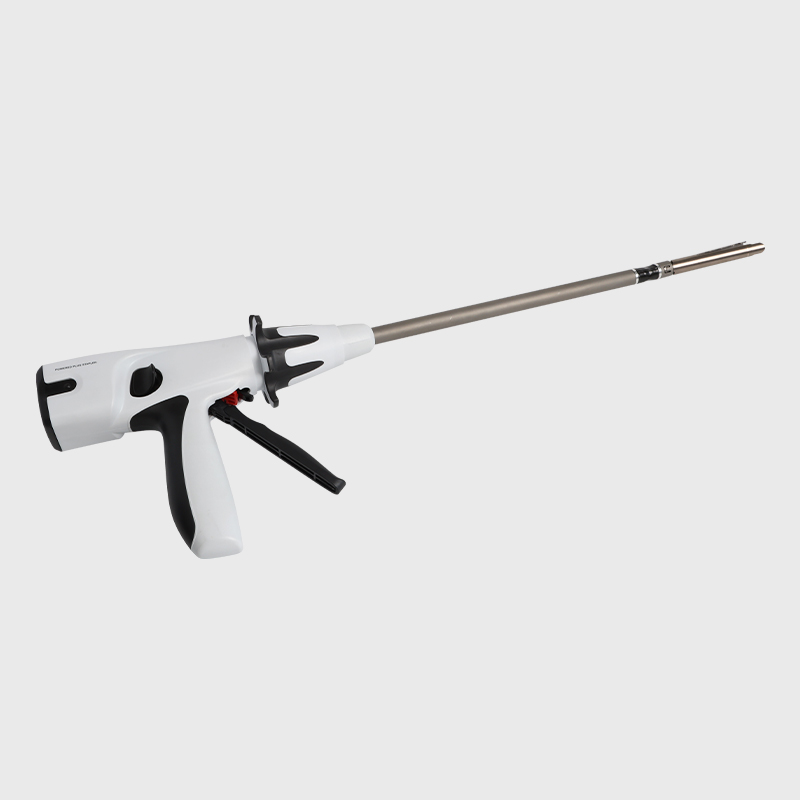 Disposable Powered Endoscopic Linear Cutting Stapler and CartridgesPowered stapler platform with dedicated cartridges, six-row staple formation, 45-degree articulation and safety lock, designed to share jaw and reload logic with manual staplers.View Product →
Access instruments are part of the same conversation, because the trocar decides the field the stapler works in. The company's optical trocar line is designed for controlled entry, and the wider surgical portfolio also covers ligation clips, clip appliers and clip removers for cases where a stapler is the wrong tool.
 Optical Trocar for Laparoscopic Access and Instrument EntryOptical trocars in multiple sizes with Type I and Type T options offer gas-tight access, detachable design and visualised puncture for laparoscopic working channels.View Product →
Because the manufacturing site also produces CSSD equipment and sterilization indicators, buyers who purchase across categories can consolidate documentation and audits with a single supplier rather than assembling a paper trail from six vendors.
Frequently Asked Questions
Q1. What is the difference between an endoscopic stapler and a circular stapler?
An endoscopic linear cutter staples and divides along a straight line. A circular stapler joins two tubular ends, typically after a low anterior resection. They are not interchangeable.
Q2. How many times can one endoscopic stapler be fired?
One firing per cartridge, and the cartridge is discarded afterwards. The reusable part is the handle on powered systems; the reload itself is never refired.
Q3. Which reload should be used for thick tissue?
The reload whose closed staple height matches the measured tissue thickness, as stated in the instruction for use. Guessing from colour alone across product families is how misfires happen.
Q4. What certifications should a stapler supplier hold?
An ISO 13485 certificate for the manufacturing site, plus CE marking or FDA clearance for the specific model. Ask for the certificate numbers, not just the logos on a brochure.
Q5. Why should the jaws stay clamped before firing?
Clamping expresses fluid and compresses tissue so staples form evenly. Manufacturer instructions for use specify a dwell time; that figure is the reference, not habit or personal preference.
Q6. Can a single-use endoscopic stapler be resterilized and reused?
No. Single-use devices are validated, labelled and traceable for one patient only. Reprocessing voids the labelling and removes the traceability that a complaint investigation depends on.
Related Products




If you are interested in our products, please consult us
CONTACT DETAILS
- Address : 116 Weihe Road, Rudong County Economic Development Zone, Nantong City, Jiangsu Province,China
- TEL: : +86-18362400158
- Email: : jayne@eraymedtech.com
PRODUCTS
NEWS CENTER
MOBILE TERMINAL
Copyright © 2025 Eray Medical Technology (Nantong) Co., Ltd.
All Rights Reserved. The information provided on this website is intended for use only in countries and jurisdictions outside of the People's Republic of China.
 Medical Devices Manufacturers
Medical Consumables Factory
 CONTACT US
