


 English
 Español
 Français
Home / News / Industry News / CDC COVID Masking Guidelines: What the Current Framework Means for Hospitals
News


CDC COVID Masking Guidelines: What the Current Framework Means for Hospitals
 2026.10.14
 Industry News
In the United States, the CDC's COVID masking guidelines are no longer one national instruction. They are a layered framework: risk-based recommendations for the general public, driven by local hospital data, plus a stricter set of infection-control rules for healthcare workers, patients and visitors. Two hospitals in the same state can run different masking policies on the same day, and a single facility's rule can change within a week of a local surge.
For infection preventionists, distributors and procurement teams, the useful question is not whether masks are recommended. It is which masks, in what quantity, and how fast a policy change has to be met. The sections below explain the framework, the metrics behind it, and what that means for buying decisions.
Content
- 1 What the CDC COVID Masking Guidelines Actually Measure
- 2 Why the Advice Arrives Later Than the Virus Does
- 3 What It Means for Hospitals, Clinics and Employers
- 4 Choosing the Right Mask When Guidance Tightens
- 5 The Waste and Supply Side of Masking Policy
- 6 Building a Mask Inventory Policy That Survives the Next Change
- 7 Frequently Asked Questions
- 7.1 Q1. Does the CDC still recommend masks for COVID-19?
- 7.2 Q2. How long can a disposable medical mask be worn?
- 7.3 Q3. Are N95 or KN95 masks required under the guidelines?
- 7.4 Q4. Which ASTM level should a hospital order?
- 7.5 Q5. Do the CDC guidelines apply to private employers?
- 7.6 Q6. Are biodegradable masks as protective as standard ones?
What the CDC COVID Masking Guidelines Actually Measure
The framework did not appear all at once. The CDC first recommended cloth face coverings for the public in April 2020, then tightened its advice for vaccinated people in July 2021 as the Delta variant spread. On February 25, 2022, the agency replaced case counts with a three-tier COVID-19 Community Level system built on hospital data. In March 2024, COVID-19 was folded into a broader Respiratory Virus Guidance that also covers influenza and RSV.
Under the Community Level framework, a county's level was set by whichever of two indicators was higher:
- New COVID-19 hospital admissions per 100,000 people over the previous seven days.
- Share of staffed inpatient beds occupied by patients with confirmed COVID-19.
| Community level | New COVID-19 admissions per 100,000 (7 days) | Staffed inpatient beds occupied by COVID-19 patients | Public indoor masking |
|---|---|---|---|
| Low | Fewer than 10 | Fewer than 10% | Not recommended |
| Medium | 10 to 19.9 | 10% to 14.9% | Considered for people at high risk |
| High | 20 or more | 15% or higher | Recommended for everyone |
The design choice matters more than the numbers. By anchoring advice to hospital capacity instead of test positivity, the CDC tied masking to the thing a health system can actually run out of: beds and staff. It also means the advice lags real transmission, because admissions rise after infections do.
Why the Advice Arrives Later Than the Virus Does
Three forces push the guidance around: variant turnover, waning immunity and better surveillance. The Omicron wave in early 2022 showed how quickly a dominant variant can erase the assumptions behind a fixed rule.
There is also a structural lag. Hospital admissions climb after infections climb, so any policy keyed to admissions trails the real wave by one to three weeks. Wastewater surveillance, which the CDC expanded nationally during the pandemic, is a leading signal; Science News reported that the revised metrics were meant to flag county risk earlier than case counts did, yet even that data arrives before most institutional policies are rewritten.
That lag is not something you fix by watching the news more closely. It is a reason to prepare supply and policy triggers in advance, so a two-week-old signal can still be answered within days.
What It Means for Hospitals, Clinics and Employers
Healthcare settings are not governed by the public recommendations. Hospitals, clinics and long-term care facilities follow separate CDC infection-control guidance, which has called for source control masking when community transmission is elevated and for N95-or-better respirators for staff caring for patients with suspected or confirmed COVID-19. Staff returning after a respiratory illness are often asked to mask for a set period after symptoms resolve.
Outside healthcare, the picture is looser. OSHA does not currently require masks in most workplaces, and state and city rules vary widely. The defensible approach is to publish your own trigger instead of reacting to headlines:
- Name the indicator you will follow — local hospital admissions, wastewater levels, or your own staff absence rate.
- Set one threshold that flips the policy, and write down the notice period employees get.
- Pre-position stock at the level you would need on day one of a mandate.
- Review the trigger quarterly, not weekly.
Choosing the Right Mask When Guidance Tightens
Most disposable medical masks sold in the United States are tested to ASTM F2100, which sets minimum performance at three levels. In the EU, EN 14683 defines Type I, Type II and Type IIR. The differences look small on a spec sheet; in practice they decide where a mask can safely be used.
minimum limits; higher is better.
Blue: ASTM Level 1 — 95% BFE, 80 mmHg fluid resistance Amber: ASTM Level 2 — 98% BFE, 120 mmHg fluid resistance Red: ASTM Level 3 — 98% BFE, 160 mmHg fluid resistance
Two things stand out. Level 2 and Level 3 share identical filtration minimums of 98 percent and differ mainly in fluid resistance, 120 mmHg against 160 mmHg. Level 1 is the lightest option at 95 percent filtration and is normally reserved for short, low-exposure visits. Buying for operating rooms or splash-heavy procedures means specifying Level 3 or EN 14683 Type IIR; for general wards, clinics and visitors, Level 1 or Level 2 is usually enough.
Filtration is only half the story. A mask that gaps at the nose bridge leaks unfiltered air no matter what the rating says, so nose-wire design and fit testing deserve as much attention as the label. Where respirator-level protection is required, the certification and fit differences between N95 and KN95 masks are worth understanding before you order.
1 — Outer layer: water-repellent spunbond 2 — Middle layer: meltblown filter 3 — Inner layer: skin-friendly spunbond
Before approving a supplier, ask for three documents: batch-level BFE and PFE test reports, a declared differential pressure ceiling so you can judge breathability, and traceability from nonwoven roll to sealed carton. Those are the same three items an auditor will request if your policy is ever challenged.
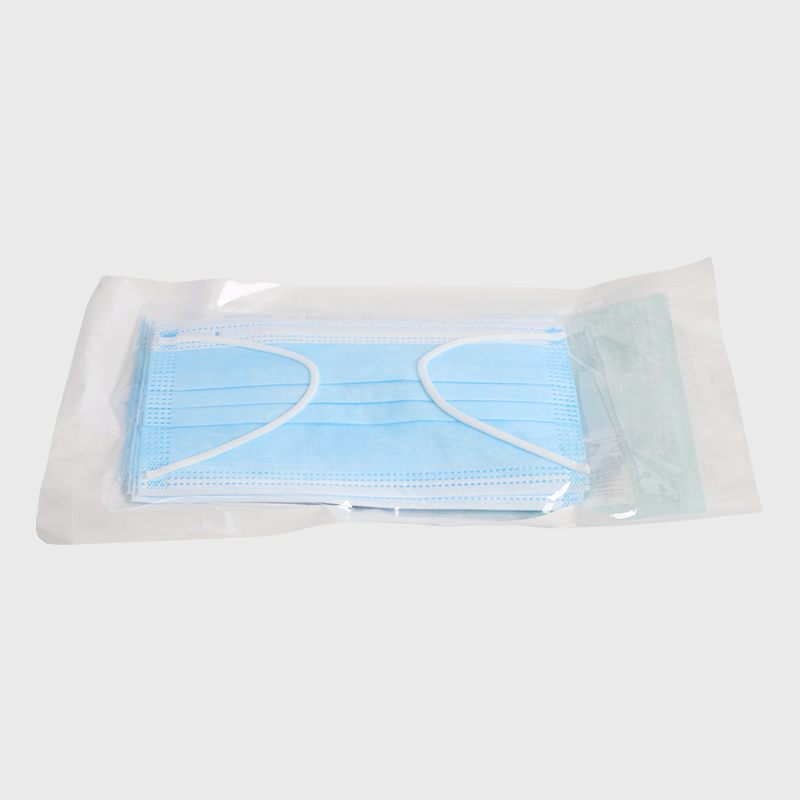 Disposable Medical 3-Ply Face MaskA 3-ply disposable medical mask with BFE >95%, adjustable nose clip, and earloop or binding belt options; review specs when checking routine medical/protective supplies.View Product →
The Waste and Supply Side of Masking Policy
Every tightening of guidance produces the same pattern: a sharp spike in single-use volume, then a slow return to baseline. That spike costs money twice, at purchase and at disposal, because used masks are classified as medical waste in many facilities.
Biodegradable disposable medical masks address the second cost. They use nonwoven materials engineered to break down faster under landfill conditions while still meeting the same bacterial filtration minimums as conventional masks. They are not a replacement for reusable respirators in high-exposure settings, but they can lower the waste footprint of routine visitor and outpatient masking.
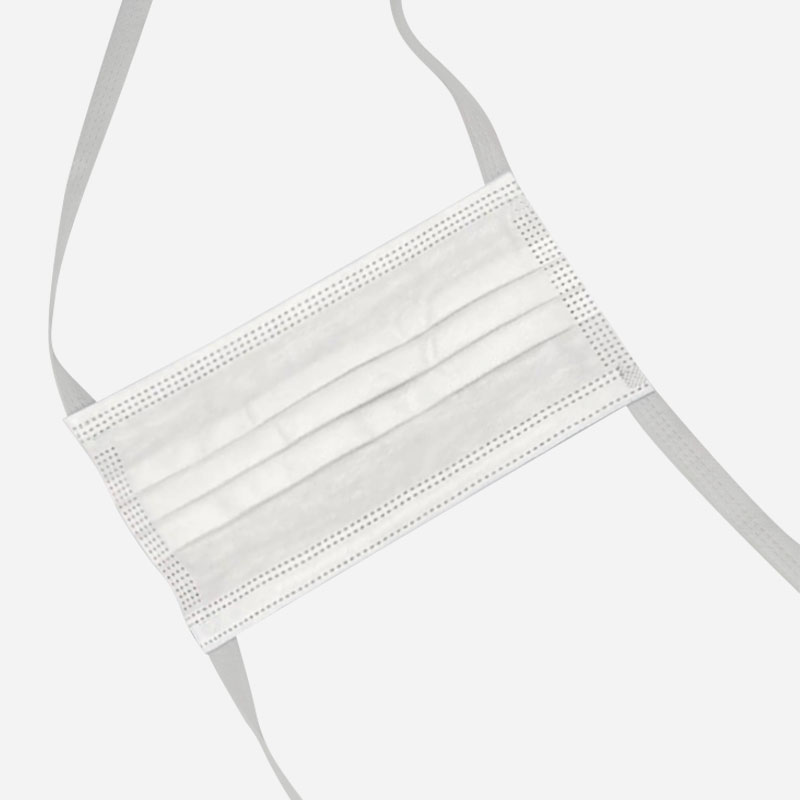 Disposable Biodegradable 3-Ply Medical Mask by ErayEray Medical Technology's biodegradable 3-ply mask has BFE >95%, PLA+PBAT materials, adjustable nose clip, and earloop or binding belt options for routine waste reduction.View Product →
Capacity matters as much as price when a mandate lands. Eray Medical Technology (Nantong) Co., LTD., is a medical device manufacturing enterprise integrating research and development, production, and sales. The company is located in Rudong Economic Development Zone, adjacent to Shanghai, with convenient transportation, and developed information. As a professional medical devices manufacturers and medical consumables factory, the company covers an area of 70 mu, with a construction area of 20310 square meters. It has an ISO Class 8 cleanroom, an ISO Class 7 microbiological laboratory, and a partial ISO Class 6 physical and chemical laboratory. Eray has established a comprehensive quality control system that encompasses the entire production process, including testing and traceability, from the ISO Class 8 cleanroom to a partial ISO Class 6 physical and chemical laboratory, ensuring that every customer receives trustworthy products.
If you need batch records, test reports or samples before a policy deadline, you can contact our team and request them directly.
Building a Mask Inventory Policy That Survives the Next Change
Guidance will change again. The facilities that handle it well tend to do five things:
- Set a baseline: measure average monthly mask use by department, not facility-wide.
- Hold a rolling buffer of at least three to six weeks of normal consumption, plus a written plan for surge volume.
- Rotate stock first-in, first-out and check shelf-life dates every quarter.
- Keep one page of documentation per product: standard, level, certification and test reports.
- Name one person who owns the trigger, so the decision does not wait for a committee.
None of this is complicated, but it has to be written down before the next update arrives, not after.
Frequently Asked Questions
Q1. Does the CDC still recommend masks for COVID-19?
Not universally. The framework is risk-based: masks are advised for the general public when local hospital indicators reach the high range, and for anyone recovering from a respiratory illness during the days after they return to normal activities.
Q2. How long can a disposable medical mask be worn?
Single-use masks are designed for one wearing. Replace them once they are damp, soiled, creased or hard to breathe through, which in clinical settings is usually within a few hours. Any longer reuse should follow a written facility policy.
Q3. Are N95 or KN95 masks required under the guidelines?
Not for the general public. In healthcare, respirators such as NIOSH-approved N95s are recommended for staff caring for patients with suspected or confirmed COVID-19 and during periods of higher transmission.
Q4. Which ASTM level should a hospital order?
Match the level to the task: Level 3 or EN 14683 Type IIR for surgery and splash-heavy procedures, Level 2 for general clinical care, and Level 1 for short visits and visitor use.
Q5. Do the CDC guidelines apply to private employers?
They are public health recommendations, not workplace regulations. Employers should check OSHA and state or local rules, then publish their own trigger-based policy with a clear notice period.
Q6. Are biodegradable masks as protective as standard ones?
Quality biodegradable masks are made to the same filtration minimums, so protection is comparable. Real-world performance still depends on fit, storage conditions and the shelf life printed on the packaging.
Related Products


If you are interested in our products, please consult us
CONTACT DETAILS
- Address : 116 Weihe Road, Rudong County Economic Development Zone, Nantong City, Jiangsu Province,China
- TEL: : +86-18362400158
- Email: : jayne@eraymedtech.com
PRODUCTS
NEWS CENTER
MOBILE TERMINAL
Copyright © 2025 Eray Medical Technology (Nantong) Co., Ltd.
All Rights Reserved. The information provided on this website is intended for use only in countries and jurisdictions outside of the People's Republic of China.
 Medical Devices Manufacturers
Medical Consumables Factory
Medical Devices Manufacturers
Medical Consumables Factory
 CONTACT US
