


 English
 Español
 Français

What Is a Medical Trocar? Complete Guide for Surgeons and Buyers
 2026.07.30
 Industry News
Content
- 1 Quick Answer: What a Medical Trocar Does and Why the Design Matters
- 2 How a Medical Trocar Works Inside Laparoscopic Surgery
- 3 Bladed Pyramidal Tip Trocars Explained
- 4 Bladeless Conical Tip Trocars Explained
- 5 Optical Trocars Explained
- 6 Side-by-Side Comparison of Trocar Tip Designs
- 7 Relative Insertion Force by Trocar Tip Design
- 8 Common Trocar Diameters and Typical Instrument Compatibility
- 9 Typical Usage Frequency of Standard Trocar Sizes
- 10 Multi-Attribute Comparison of Trocar Tip Designs
- 11 How Surgeons and Procurement Teams Select the Right Trocar
- 12 Trocar Applications Across Surgical Specialties
- 13 Manufacturing Standards Behind a Reliable Medical Trocar
- 14 Sourcing Trocars for Distribution and Private Label Programs
- 15 Handling, Storage, and Setup Considerations Before Use
- 16 Frequently Asked Questions
- 16.1 What is a medical trocar
- 16.2 What is a trocar used for
- 16.3 How does a laparoscopic trocar work
- 16.4 What sizes do trocars come in
- 16.5 What is the difference between a trocar and a cannula
- 16.6 What is an optical trocar
- 16.7 What are trocars made of
- 16.8 How do trocar valves work
- 16.9 How is gas leakage prevented in laparoscopic surgery
- 16.10 What is the standard trocar size
Quick Answer: What a Medical Trocar Does and Why the Design Matters
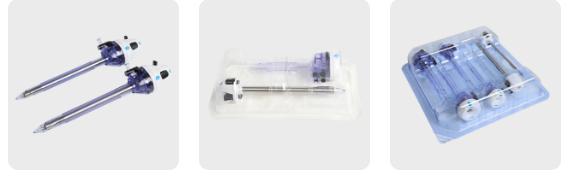
A medical trocar is a surgical instrument used to puncture the abdominal wall and create a working channel into the abdominal cavity during laparoscopic procedures. It typically consists of a sharp or blunt-tipped obturator paired with a hollow cannula, and once the puncture needle is withdrawn, the cannula remains in place to maintain pneumoperitoneum and provide a passage for the laparoscope and surgical instruments used throughout the operation.
Three tip designs dominate current laparoscopic practice: bladed pyramidal tips that cut through tissue layers, bladeless conical tips that separate tissue fibers with less cutting trauma, and optical tips that allow the surgeon to view each tissue layer during insertion. Choosing between them generally comes down to the surgical approach, the abdominal wall thickness of the patient, and the working diameter the procedure requires, and matching those factors to the correct trocar size and tip design is the detail that most affects a smooth, controlled port placement.
How a Medical Trocar Works Inside Laparoscopic Surgery
The Core Components
Every standard trocar assembly is built from two working parts. The obturator, sometimes called the puncture needle, is the inner component that creates the initial passage through the abdominal wall. The cannula is the outer hollow sleeve left behind once the obturator is removed, and it is this sleeve that surgical instruments and the laparoscope pass through for the remainder of the procedure.
Establishing and Maintaining Pneumoperitoneum
Once the cannula is seated, carbon dioxide gas is introduced through an insufflation port to inflate the abdominal cavity, a state referred to as pneumoperitoneum. This creates a stable, elevated working space that separates the abdominal wall from internal organs, giving the surgical team a clear field of view and enough room to maneuver instruments safely. A trocar with a well-sealed valve system is central to keeping that pressure stable throughout the case, since gas leakage around the cannula can collapse the working space and interrupt the procedure.
Trocar Versus Cannula: A Common Point of Confusion
The terms trocar and cannula are frequently used interchangeably in casual conversation, but they describe different parts of the same assembly. The trocar, strictly speaking, refers to the complete instrument including the sharp or blunt obturator used for insertion, while the cannula is only the tube that remains once the obturator has been withdrawn. Procurement teams and clinical staff benefit from keeping this distinction clear when comparing catalog listings, since some suppliers list obturators and cannulas as separate components.
Bladed Pyramidal Tip Trocars Explained
Design Characteristics
Bladed trocars use a pyramidal or triangular cutting tip designed to slice cleanly through the layers of the abdominal wall. Because the tip actively cuts rather than separates tissue, the amount of force needed to advance the instrument through the fascia is generally lower than with a bladeless design.
Where Bladed Trocars Are Commonly Used
This tip design remains widely used for secondary port placement, where the surgeon has direct visualization of the entry point from an already established primary port, reducing the reliance on tactile feel alone. It is also a familiar option in training environments, since the predictable cutting action offers a consistent learning experience for developing port placement technique.
Considerations to Weigh
Because the cutting tip creates a clean incision through all abdominal wall layers, the resulting fascial defect can be slightly larger relative to the cannula diameter than with a bladeless entry, which is one reason some surgical teams pay closer attention to fascial closure at larger bladed port sites.
Bladeless Conical Tip Trocars Explained
Design Characteristics
Bladeless trocars use a conical or tapered tip that spreads and separates muscle and fascial fibers rather than cutting through them. This dilating action typically requires more controlled, steady insertion force compared with a bladed tip, since the surgeon is working the tissue apart layer by layer instead of slicing through it in one motion.
Where Bladeless Trocars Are Commonly Used
Because the fibers separate and tend to close back around the cannula rather than being cut, bladeless trocars are frequently selected for primary port placement and for patients where minimizing the fascial defect is a priority. Many surgical teams also favor this design when a port site will not require a formal fascial closure step.
Considerations to Weigh
The steadier, more deliberate force required for bladeless insertion means technique and consistent pressure control matter more than with a bladed tip, and surgeons newer to laparoscopic access sometimes find the learning curve slightly longer before the motion feels routine.
Optical Trocars Explained
Design Characteristics
An optical trocar is built with a transparent obturator tip that allows the laparoscope to be inserted directly into the trocar itself, so the surgeon can visualize each individual layer of the abdominal wall as the instrument advances. This turns initial entry from a largely tactile process into one guided by direct, real-time visualization.
Where Optical Trocars Are Commonly Used
This design is often selected for primary entry, particularly in patients with prior abdominal surgery where adhesions may be present, since watching each tissue plane pass by on screen gives the surgical team additional confirmation of a clear path before advancing further.
Considerations to Weigh
Optical entry generally takes a more deliberate, methodical pace than a standard bladed or bladeless insertion, and it requires the laparoscope to be connected and ready before the entry step begins, which is a small workflow difference procurement and clinical teams often plan around.
Side-by-Side Comparison of Trocar Tip Designs
| Attribute | Bladed | Bladeless | Optical |
|---|---|---|---|
| Tip mechanism | Pyramidal cutting edge | Conical dilating tip | Transparent viewing tip |
| Insertion force needed | Lower | Moderate to higher | Moderate |
| Visualization during entry | Indirect | Indirect | Direct, real time |
| Typical fascial defect | Larger, clean cut | Smaller, self approximating | Smaller, self approximating |
| Common port role | Secondary ports | Primary or secondary ports | Primary entry, prior surgery cases |
Relative Insertion Force by Trocar Tip Design
The tip geometry of a trocar changes how much controlled force a surgeon typically applies to advance it through the abdominal wall. The chart below places the three tip designs on a relative insertion force index, where a lower value reflects a tip that passes through tissue with comparatively less applied force.
Values represent a general relative pattern described in surgical instrument design literature and can vary by patient anatomy and technique.
Common Trocar Diameters and Typical Instrument Compatibility
Trocar size is measured by the inner diameter of the cannula, which determines the maximum diameter of laparoscope or instrument that can pass through it. The line chart below shows how compatible instrument size scales alongside the four most common trocar diameters used in general laparoscopic practice.
Compatible instrument diameter is slightly smaller than the port label due to wall thickness and valve clearance, and figures shown are typical rather than fixed across every catalog.
Typical Usage Frequency of Standard Trocar Sizes
Not every port in a laparoscopic procedure uses the same diameter. The bar chart below shows a general pattern of how often each standard size tends to appear across a typical multi-port general laparoscopic case.
Percentages reflect a general pattern across common multi-port procedures and vary by surgical specialty and individual case requirements.
Multi-Attribute Comparison of Trocar Tip Designs
Since no single figure fully describes how a trocar behaves during a case, the radar chart below layers six design attributes for bladed, bladeless, and optical trocars on the same scale, making it easier to see where each design naturally leads.
Each axis reflects a general zero to ten relative scale based on common design characteristics rather than a specific tested case.
How Surgeons and Procurement Teams Select the Right Trocar
Selecting a trocar generally starts with the surgical approach and the specific role a given port will play in the procedure. The scenarios below outline common patterns seen across general laparoscopic practice.
- Single-port procedures. A compact multi-channel access point where cannula design and seal quality carry extra weight, since several instruments share one entry site.
- Standard multi-port laparoscopy. A common mix of one primary optical or bladeless port alongside several smaller bladed or bladeless secondary ports.
- Higher BMI patients. A thicker abdominal wall that often calls for longer cannula lengths and a tip design suited to consistent force through additional tissue depth.
- Pediatric procedures. Smaller diameter trocars sized to a smaller working cavity, where a bladeless or optical tip is often favored for its more controlled entry.
- Robotic-assisted procedures. Port placement coordinated with the robotic arm layout, where cannula stability and a secure seal matter for maintaining a steady pneumoperitoneum across a longer case.
- Training and teaching environments. A predictable, repeatable tip design that helps trainees build consistent technique before moving to more advanced entry methods.
Across every scenario, cannula length, valve type, and diameter still need to match the instruments the surgical team plans to use throughout the case, since a mismatch at the port level can limit instrument choice mid-procedure.
Trocar Applications Across Surgical Specialties
While general surgery remains the most familiar setting for trocar use, several specialties rely on the same core instrument with adjustments to size, length, or tip design suited to their specific procedures.
General and Gastrointestinal Surgery
Procedures such as laparoscopic cholecystectomy and hernia repair commonly use a mix of 5mm and 10 to 12mm ports, with tip design often chosen based on whether the port will require formal fascial closure at the end of the case.
Gynecologic Surgery
Laparoscopic gynecologic procedures frequently favor smaller diameter ports for secondary access, paired with a primary port sized to accommodate the laparoscope and any specimen retrieval needs specific to the procedure being performed.
Bariatric and Upper GI Surgery
Higher BMI patients typically require longer cannula lengths to reach the working cavity reliably, and consistent seal performance becomes especially important given the longer average case duration common to bariatric procedures.
Manufacturing Standards Behind a Reliable Medical Trocar
Consistency is what surgical teams rely on most when it comes to a medical trocar, since a valve that seals reliably and a tip geometry that behaves the same way case after case are what allow a surgical team to trust the instrument without adjusting technique each time. Production environments built around controlled cleanroom conditions, dimensional inspection, and valve leak testing are what make that batch to batch consistency possible.
Eray Medical Technology (Nantong) Co., Ltd operates as an integrated medical device enterprise combining research, production, and sales, with a manufacturing base located in the Rudong Economic Development Zone in Jiangsu Province. The facility spans a building area of 20,310 square meters and includes a class 100,000 purified production workshop, a class 10,000 microbiology testing room, a local class 100 physical and chemical laboratory, and a standardized storage system covering both raw materials and finished products.
Since launching its first product batch in 2013, the company has expanded its catalog to include protective masks, nursing consumables, sensory control consumables, and surgical instruments, positioning it as a medical trocar manufacturer and laparoscopic trocar manufacturer supplying disposable medical solutions to institutions worldwide.

Sourcing Trocars for Distribution and Private Label Programs
Distributors and procurement teams evaluating a disposable trocar supplier for ongoing programs generally look at catalog breadth across bladed, bladeless trocar, and optical trocar options, along with the consistency of valve performance and seal quality from batch to batch. A surgical trocar manufacturer capable of supporting OEM disposable trocar programs and private label packaging gives buyers more flexibility than sourcing separate tip designs from separate factories.
- Full size range coverage from 5mm through larger specimen retrieval diameters
- Consistent valve and seal performance across production batches
- Support for OEM labeling and packaging arrangements
- Responsiveness for custom configurations requested by a specific institution or distributor
As a China medical trocar manufacturer operating an OEM laparoscopic trocar factory, Eray Medical Technology has built long-term cooperative relationships with medical institutions and distributors both domestically and internationally, supporting buyers who need dependable, consistent supply across a broad product range rather than a single item.
Handling, Storage, and Setup Considerations Before Use
Signs a Package May Be Compromised
- A torn, punctured, or visibly damaged outer pouch
- Missing or unreadable lot number and expiration date printing
- Discoloration or moisture inside a pouch that should otherwise appear dry and sealed
- A seal indicator that has not changed as expected during sterilization verification
Best Practices Before the Procedure Begins
Confirming the valve and seal move freely before insertion, checking that the obturator locks securely into the cannula, and verifying the insufflation port connects cleanly to the gas line all take only a moment but help the surgical team avoid interruptions once the case is underway. Storing unopened trocars in a dry, temperature-controlled area away from direct sunlight helps preserve packaging integrity until the instrument is ready to be opened at the point of use.
Frequently Asked Questions
-
What is a medical trocar
A medical trocar is a surgical instrument used to puncture the abdominal wall and create a working channel for laparoscopic instruments and the laparoscope during minimally invasive surgery.
-
What is a trocar used for
Trocars establish port access into the abdominal cavity, allow carbon dioxide gas to create pneumoperitoneum, and provide a stable channel for passing instruments in and out during a procedure.
-
How does a laparoscopic trocar work
The obturator tip creates the initial passage through the abdominal wall, and once it is withdrawn, the remaining cannula stays in place as a sealed channel for gas and instruments throughout the case.
-
What sizes do trocars come in
Common diameters include 5mm, 10 to 11mm, 12mm, and 15mm, with the choice depending on the instrument or laparoscope that needs to pass through the port during the procedure.
-
What is the difference between a trocar and a cannula
The trocar refers to the complete instrument including the puncture obturator, while the cannula is only the hollow tube that remains in the abdominal wall once the obturator has been removed.
-
What is an optical trocar
An optical trocar has a transparent tip that allows the laparoscope to be inserted directly into it, letting the surgeon view each abdominal wall layer during entry rather than relying on feel alone.
-
What are trocars made of
Disposable trocars are typically made from medical grade polymers for the cannula and housing, often paired with a stainless steel obturator tip on bladed designs for consistent cutting performance.
-
How do trocar valves work
Trocar valves use a spring loaded or duckbill style seal that closes around inserted instruments to maintain pneumoperitoneum while still allowing instruments to pass in and out freely during the case.
-
How is gas leakage prevented in laparoscopic surgery
A properly seated cannula combined with a well-functioning valve system keeps carbon dioxide gas contained within the abdominal cavity, and checking valve function before insertion helps confirm a reliable seal.
-
What is the standard trocar size
There is no single standard size, since the right diameter depends on the instrument being used, though 5mm and 10 to 12mm ports are the most commonly used sizes across general laparoscopic procedures.
Related Products

If you are interested in our products, please consult us
CONTACT DETAILS
- Address : 116 Weihe Road, Rudong County Economic Development Zone, Nantong City, Jiangsu Province,China
- TEL: : +86-18362400158
- Email: : jayne@eraymedtech.com
PRODUCTS
NEWS CENTER
MOBILE TERMINAL
Copyright © 2025 Eray Medical Technology (Nantong) Co., Ltd.
All Rights Reserved. The information provided on this website is intended for use only in countries and jurisdictions outside of the People's Republic of China.
 Medical Devices Manufacturers
Medical Consumables Factory
Medical Devices Manufacturers
Medical Consumables Factory
 CONTACT US
