


 English
 Español
 Français
Home / News / Industry News / How Does Masking Work? The Science Behind Face Mask Particle Filtration
News


How Does Masking Work? The Science Behind Face Mask Particle Filtration
 2026.09.30
 Industry News
Standing in front of a stockroom shelf packed with disposable surgical masks, an infection control manager has one practical question: does this actually block the virus, or only the visible droplets? The evidence-based answer is yes — but with important qualifiers. Masking works through four simultaneous physical filtration mechanisms plus a simple barrier effect, and the protection a mask provides depends on three variables you can control: material construction, face seal fit, and compliance with recognized standards. This article explains each of those variables from the perspective of someone who needs to specify, verify, or purchase masks that genuinely perform.
Content
- 1 The Four Mechanisms Behind Mask Filtration
- 2 Particle Sizes: What Masking Does and Does Not Need to Catch
- 3 Three Layers Inside a Disposable Medical Mask
- 4 Fit Leakage: The Weak Point That Is Not in the Filter
- 5 Source Control, Personal Protection, and One-Way Masking
- 6 A Procurement Checklist for Medical Mask Buyers
- 7 Frequently Asked Questions About How Masking Works
- 7.1 Q1. Does a surgical mask filter out single virus particles?
- 7.2 Q2. Why does a mask cause glasses to fog?
- 7.3 Q3. Is it safe to breathe through a mask for hours?
- 7.4 Q4. How often should a disposable medical mask be changed?
- 7.5 Q5. Are biodegradable masks as effective as regular masks?
- 7.6 Q6. Does masking protect the wearer or only people around them?
The Four Mechanisms Behind Mask Filtration
A medical mask is a fibrous filter, not a sieve. Unlike a strainer that blocks everything above a fixed opening size, a nonwoven filter captures particles across a wide range of sizes through four mechanisms acting at the same time:
- Inertial impaction. When the airstream bends around a fiber, particles larger than about 1 µm keep moving forward by inertia and crash into the fiber.
- Interception. A particle that follows the airstream but passes within one particle radius of a fiber touches the fiber and sticks. This captures many particles in the 0.1–1 µm range.
- Diffusion. Particles smaller than roughly 0.1 µm are buffeted by air molecules (Brownian motion), wander off the airflow path, and randomly collide with fibers.
- Electrostatic attraction. Melt-blown fibers are given a permanent electrostatic charge during manufacturing. Oppositely charged particles are pulled to the fiber surface even if they never physically touch it.
The combination produces a filter whose lowest efficiency point is around 0.3 µm — the "most penetrating particle size" (MPPS). The isometric diagram below shows the three-layer structure that houses these mechanisms.
| Mechanism | Particle size range | Physical driver |
|---|---|---|
| Inertial impaction | Greater than 1 µm | Particle momentum |
| Interception | 0.1–1 µm | Fiber spacing and particle radius |
| Diffusion | Less than 0.1 µm | Brownian motion |
| Electrostatic attraction | 0.02–2 µm | Fiber surface charge |
Particle Sizes: What Masking Does and Does Not Need to Catch
Human respiration produces a spectrum of particles. Coughing and sneezing release coarse droplets up to 100 µm or more. Normal speech generates mostly aerosol particles under 10 µm, many of them in the 1–5 µm range. Viruses themselves are only about 0.1 µm in diameter, but they almost never travel alone — virions are carried inside respiratory droplets and aerosols. This is why a surgical mask certified to filter 0.1 µm particulate matter (PFE ≥ 98%) is a meaningful line of defense, even though an isolated virus would be invisible to a mechanical sieve.
The efficiency curve below explains why electrostatic media matters. A purely mechanical filter loses efficiency near 0.3 µm. Adding electrostatic charge keeps capture efficiency high even for particles of 0.1 µm or smaller — exactly the size range of virion-containing aerosols.
Three Layers Inside a Disposable Medical Mask
A standard disposable medical mask is built from three nonwoven layers, each with a specific job:
- Outer spunbond layer. Blocks large droplets and splashes, gives the mask structural shape.
- Melt-blown layer. The filtration core, made of electrostatically charged polypropylene microfibers 1–5 µm in diameter.
- Inner spunbond layer. Absorbs moisture from breathing and provides a soft surface against the skin.
The melt-blown layer carries the electrostatic charge that powers two of the four mechanisms — electrostatic attraction itself, and improved interception of fine particles. Because the charge can decay when the fabric becomes wet or physically degraded, the outer and inner spunbond layers also protect the filter from droplets and humidity through the entire wearing period.
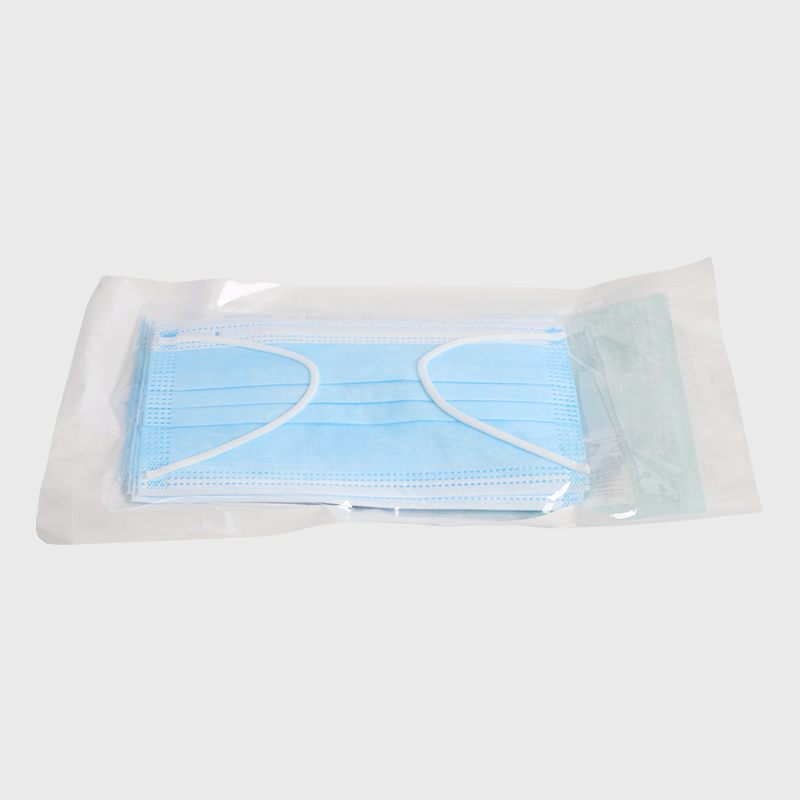 Eray Disposable 3-Ply Medical Face Mask with BFE 95%This three-layer disposable mask uses water-blocking outer and skin-friendly inner layers to protect the melt-blown filter, maintaining filtration performance during extended wear. Its adjustable nose clip and soft ear loops support a secure fit.View Product →
For buyers concerned with medical waste, biodegradable masks replace part of the conventional polymer with bio-based material while keeping the same three-layer architecture and the same filtration requirements. Eray's disposable biodegradable medical mask is one example: it maintains the spunbond–melt-blown–spunbond structure while offering a more environmentally conscious end-of-life profile.
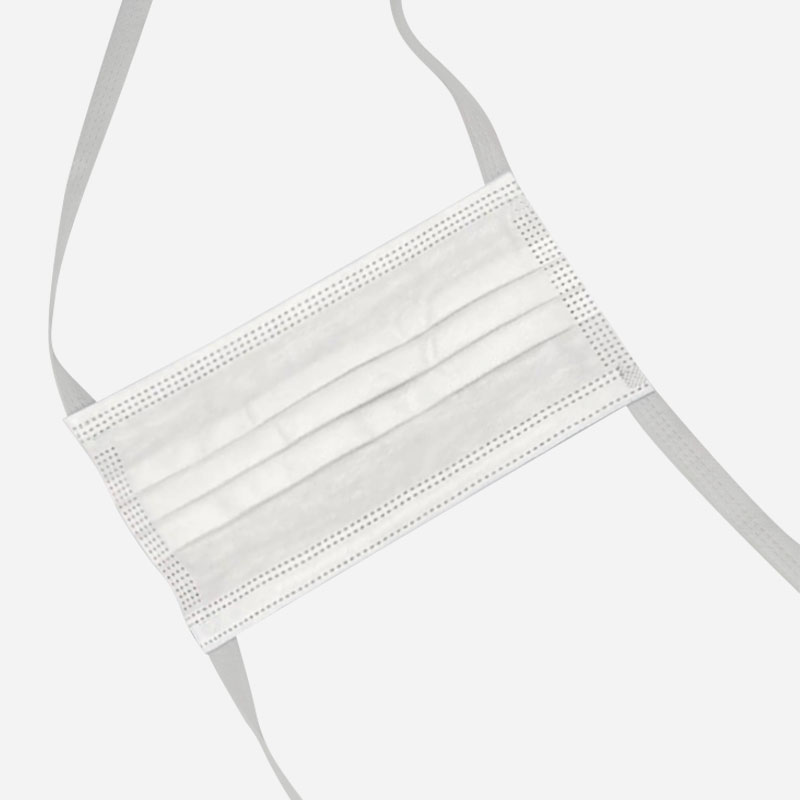 Eray Disposable Biodegradable 3-Ply Medical Face MaskMade from certified biodegradable materials like PLA+PBAT, this mask keeps the same three-layer spunbond-melt-blown structure and BFE 95% filtration while reducing plastic waste, offering an eco-friendly option for buyers concerned about medical waste.View Product →
Fit Leakage: The Weak Point That Is Not in the Filter
Filtration efficiency is measured on a flat sample of material, but the protection a wearer receives is determined by what happens at the edges of the mask. A mask that does not seal leaves gaps at the nose bridge, cheeks, and chin. During inhalation, air follows the path of least resistance, and unfiltered air can enter through those gaps. This is why the U.S. Centers for Disease Control and Prevention stresses the correct donning technique: pinch the nose band into shape, position the mask over the nose and under the chin, and make sure the mask hugs the face without visible gaps.
The chart below illustrates the practical consequence. A filter capable of 95% efficiency loses almost half of its protective value when inward leakage reaches 50% — the regime typical of a loosely worn surgical mask.
A simple fit checklist covers the most common failure points:
- Pinch the nose wire across the full width of the bridge, not just in the center.
- Pull the mask below the chin so no skin is exposed between the mask edge and the jawline.
- Check for air escaping at the sides while exhaling forcefully, and re-adjust until the mask perimeter stays sealed.
- Replace the mask if the ear loops stretch and create lateral gaps.
For surgical masks, which are looser by design, the same principle applies at a more forgiving level. Following a correct mask-wearing technique closes most of the performance gap between bench testing and real-world use.
Source Control, Personal Protection, and One-Way Masking
Masking works in two directions. Source control is the barrier that prevents an infected person's droplets from reaching the environment; personal protection is the filter that cleans the air the wearer inhales. A study in the New England Journal of Medicine found that surgical masks substantially reduced the detection of influenza virus in respiratory droplets exhaled by infected patients, confirming the source-control benefit. Evidence reviewed by the U.S. National Institutes of Health similarly concludes that one-way masking is still worth wearing a mask when not everyone around you is masked — the protection is lower than universal masking but far from zero.
In healthcare terms, this means a mask protects both the clinician and the patient. In purchasing terms, it means mask performance cannot be judged purely by the material's laboratory test certificate. The mask must also be worn consistently, and it must be available in the right sizes and formats so that staff do not improvise. A practical reading of the disposable mask protection mechanism is that procurement choices and fitting instructions are two halves of the same equation.
A Procurement Checklist for Medical Mask Buyers
When a hospital or distributor selects masks, three documents matter most: the standard that defines filtration and breathability, the test report that proves the lot meets it, and the quality system behind the production line. The main standards are summarized below.
| Standard | Filtration requirement | Typical application |
|---|---|---|
| EN 14683 Type IIR | BFE ≥ 98%, delta-P ≤ 40 Pa/cm² | Medical and surgical use, fluid-resistant |
| ASTM F2100 Level 1 | BFE ≥ 95%, PFE ≥ 95% | Low-risk procedures |
| ASTM F2100 Level 2 | BFE ≥ 98%, PFE ≥ 98% | Moderate-risk procedures |
| ASTM F2100 Level 3 | BFE ≥ 98%, PFE ≥ 98% | High-risk procedures, higher fluid resistance |
| NIOSH N95 | ≥ 95% filtration at 0.3 µm NaCl | Respirator protection when fit-tested |
Breathability matters as much as filtration. A mask that is difficult to breathe through will be removed by the wearer, which negates the entire protective function. That is why Type IIR requires a differential pressure no higher than 40 Pa/cm², and why the ASTM levels specify similar pressure limits.
Behind the certification, the production environment determines whether every set of 50,000 masks actually matches the one test report. Eray Medical Technology (Nantong) Co., Ltd. is a medical device manufacturing enterprise integrating research and development, production, and sales. The company is located in Rudong Economic Development Zone, adjacent to Shanghai, with convenient transportation and developed information. As a professional medical devices manufacturer and medical consumables factory, the company covers an area of 70 mu (about 4.7 hectares), with a construction area of 20,310 square meters. It has an ISO Class 8 cleanroom, an ISO Class 7 microbiological laboratory, and a partial ISO Class 6 physical and chemical laboratory. Eray has established a comprehensive quality control system that encompasses the entire production process, including testing and traceability, from the ISO Class 8 cleanroom to a partial ISO Class 6 physical and chemical laboratory, ensuring that every customer receives trustworthy products.
Frequently Asked Questions About How Masking Works
Q1. Does a surgical mask filter out single virus particles?
Not as a sieve would. Viruses are emitted inside respiratory droplets and aerosols, and the electrostatic melt-blown layer captures particles down to about 0.1 µm, so the mask blocks the carriers and most of the free virions along with them.
Q2. Why does a mask cause glasses to fog?
Exhaled air escapes through the gap at the nose bridge when the nose wire is not molded tightly. Re-shaping the nose band and adjusting the upper edge creates a seal that redirects airflow and reduces fogging.
Q3. Is it safe to breathe through a mask for hours?
Yes. Multiple studies, including reviews of healthcare workers, found no clinically significant drop in blood oxygen saturation (SpO2) or rise in carbon dioxide levels during proper, continuous mask use.
Q4. How often should a disposable medical mask be changed?
Change it when it becomes wet, visibly dirty, damaged, or hard to breathe through, and always after contact with a patient who is suspected or confirmed to be infectious. Facility policy often sets a practical interval of about four hours on continuous use.
Q5. Are biodegradable masks as effective as regular masks?
Yes, if they meet the same certification limits. Biodegradability concerns the material's end-of-life decomposition, not its filtration performance; a certified biodegradable mask still passes the same BFE, PFE, and breathability tests.
Q6. Does masking protect the wearer or only people around them?
Both. Masks reduce droplets exhaled by an infected person (source control) and reduce the dose of airborne particles an uninfected person inhales. The level of protection to the wearer increases with fit quality and the mask's filtration standard.
Related Products
If you are interested in our products, please consult us
CONTACT DETAILS
- Address : 116 Weihe Road, Rudong County Economic Development Zone, Nantong City, Jiangsu Province,China
- TEL: : +86-18362400158
- Email: : jayne@eraymedtech.com
PRODUCTS
NEWS CENTER
MOBILE TERMINAL
Copyright © 2025 Eray Medical Technology (Nantong) Co., Ltd.
All Rights Reserved. The information provided on this website is intended for use only in countries and jurisdictions outside of the People's Republic of China.
 Medical Devices Manufacturers
Medical Consumables Factory
Medical Devices Manufacturers
Medical Consumables Factory
 CONTACT US
